Everyone has their own way of solving problems. But what if there was an almost guaranteed way for you to come up with better solutions? Commonly used in UX design and top design companies is a thing called ideation techniques. This long list of techniques helps designers and developers come up with new concepts, insights, and real solutions for real product issues. By using some of these methods, you can open your mind to more possibilities and more innovative solutions.
I recently worked on a project where ideation techniques were extremely useful. The task at hand was to solve a large number of app issues, based off real user complaints. They were turned into point of view statements (also called POV statements) that became the focal point that needing solving. With a task this big I needed to use ideation techniques to help me come up with a variety of ideas. While some of the methods are self-explanatory, like sketching or storyboarding… others are a little more abstract. But these techniques can be used whether you are a designer or not, as long as you know about the problem and know the product.
The following are a few of the techniques that aren’t widely known but have been incredibly helpful with my project this week.
Mind Map
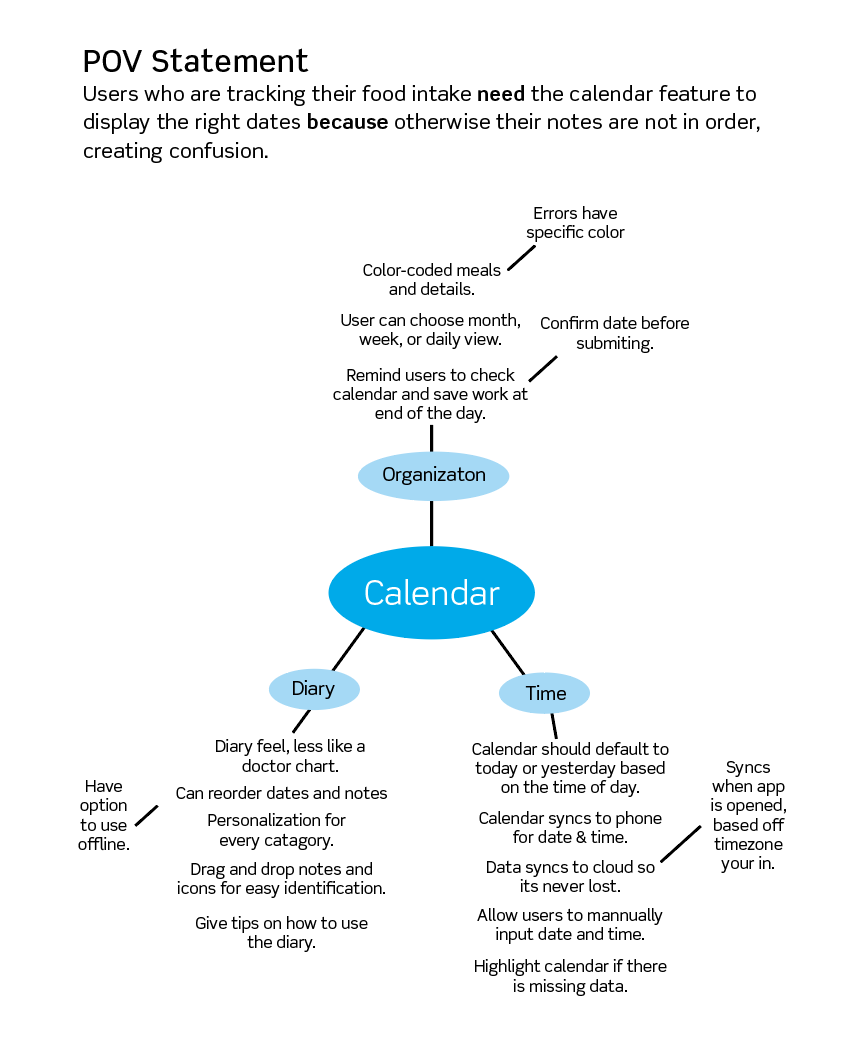
Mind Mapping is what it sounds like and there are plenty of sites that can help you create one. You will start with a topic or specific word and create “branches” or subtopics around this word. From there you can continue to add concepts or additional words that relate to the subtopic. This process helps you visualize features and see how things relates to each other. Once created, going back and looking at your mind map throughout a project can also be very useful.
For my project I created a mind map for the calendar in the MyFitnessPal app. The issue of the calendar not syncing up correctly, led me down a path where my mind map was based off of how to solve this issue and what a new calendar could look like. Below I included features, how it would be organized, and how the date and time would work.
Brain Dump
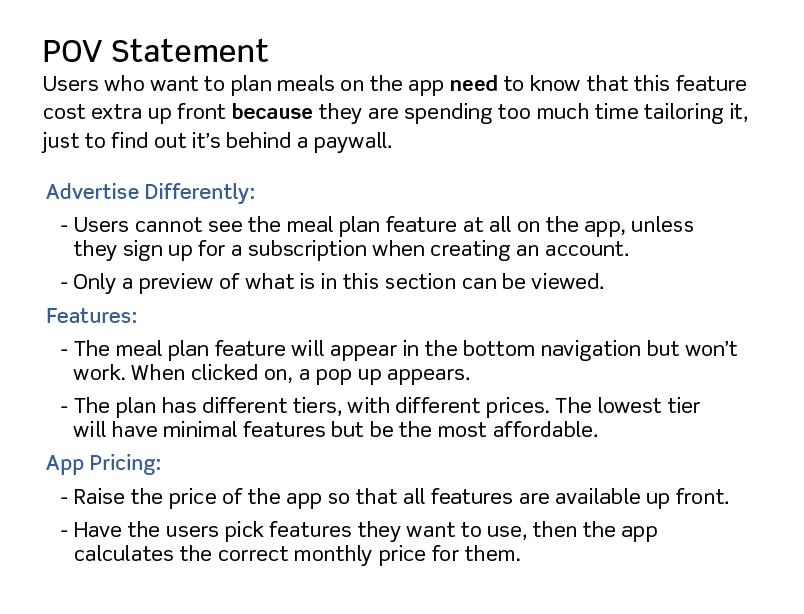
Doing a brain dump is another helpful method that involves quickly writing down all ideas and thoughts that come to you when thinking about the issue. This will hopefully help you to unload all your thoughts and also free up your mind to think up more creative solutions. To do this, set a timer and write the problem down. Without worrying about context or details, write down all thoughts. You can later organize them and add to them, but you should have a hunch of what solutions are worth following through on.
Below you can see my brain dump, where you will notice my ideas are grouped into three categories. This was done after I came up with the ideas. Of course, there were some that did not even make it onto the final draft, but this method helped me think deeper about how a new meal plan feature would appear to users using MyFitnessPal. By writing my thoughts out, I was able to look at all the ideas together and then expand on them.
SCAMPER
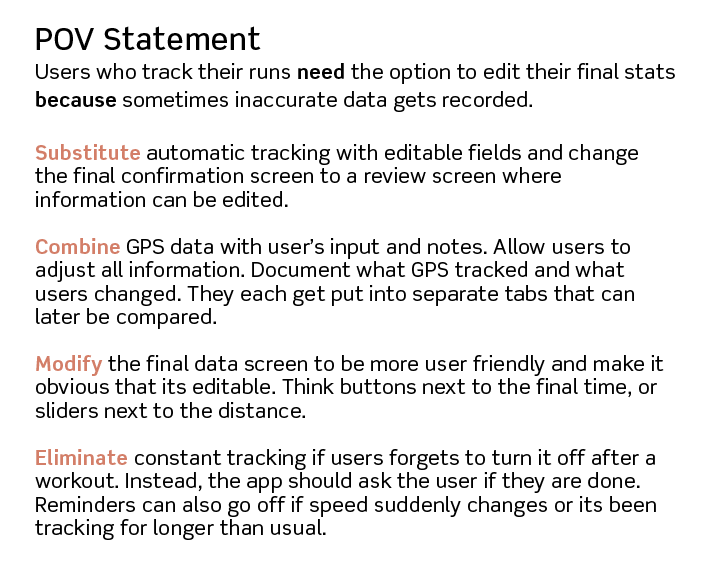
SCAMPER is a popular UX method that you may have heard of. It’s an acronym that stands for Substitute, Combine, Adapt, Modify, Put to another use, Eliminate and Rearrange. Each letter in the word represents an approach to coming up with a solution. As you go through each letter, or step, you will notice your idea going through iterations of refinements and enhancements. But it’s important to remember that you don’t necessarily have to define all the letters. If you feel stuck on one, move to the next one, or if you feel like you have combined two of them, that’s fine too.
As you can see in my SCAMPER example, I did not use all the letters, but I made sure to write in as much detail as I could. When trying to figure out a way to track runs for Strava’s app, I discovered through SCAMPER that all fields would have to be editable for users. Only showing final data recorded was frustrating and by making the final screen editable, it would make the whole app more user friendly. I was also able to come up with the idea of the app asking the user if they are done working out, so that non workout movements wouldn’t disrupt the data.
Analogies
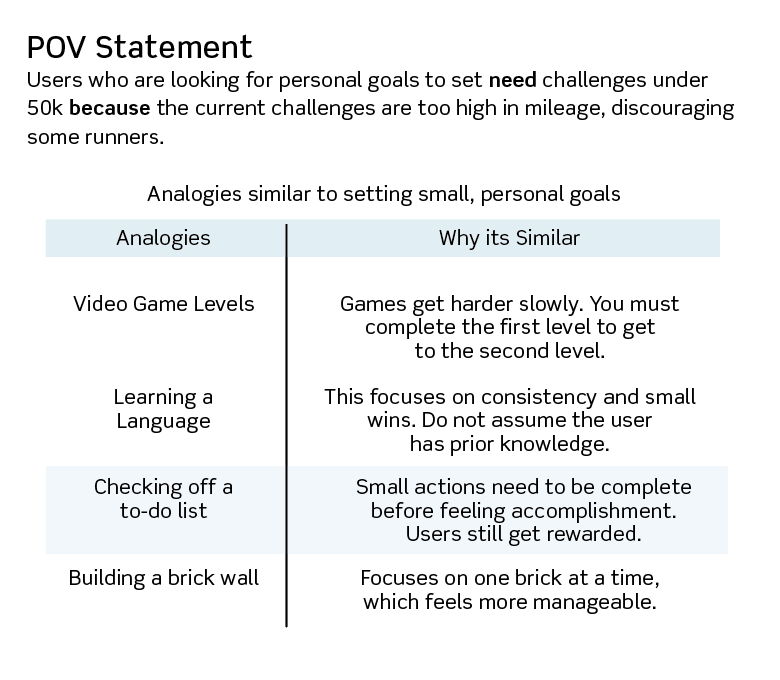
Writing analogies was a fun way to open my mind to other problems and solutions. I found this most enjoyable, as it turns your focus onto what works for similar but slightly different problems. Writing an analogy for your problem starts with a topic or scenario that is similar and then you would make a point about how it relates to the main problem.
For my project I wrote analogies that related to setting small personal goals. The one that sparked my best idea came from the checking off a to do list analogy. It’s very similar to my problem because here small actions need to be taken before completing a larger action. This eventually led me to the solution for the app. Which was to have a virtual coach that would send you notifications or a voice message motivating you to run a bit longer after every workout. Then users would get a chance to win prizes as they run farther each time. This solves the issue of runners needing reward while also building up their stamina and miles.
Worst Possible Idea
The worst possible idea method is another technique that doesn’t pressure you to figure out the best solution immediately. In fact, it does quite the opposite. For this method, write out your worst ideas related to your issue. They can be as silly and wacky as you want. The point is to analyze the bad ideas and to then dissect them and turn them into good ideas. You can usually do this by taking the opposite approach or substituting certain parts, to then create a good solution.
I successfully used this method when tackling how to solve Strava’s speedometer issue, which wasn’t user friendly and always lagged. My wild idea of showing the speedometer speed with pictures rather than numbers became my starting point to my solution. Instead of using childish pictures, I swapped it for a visual graph or chart. This way the speedometer wouldn’t need to calculate an exact number, but it would still give valuable information and a basic idea of how fast they were going. Thinking about the worst ideas, allowed me to think deeper and really be creative in this process.

Conclusion
While there are plenty more ideation techniques not listed in this article, you should by now see their worth in the design industry. These methods are fool proof ways to get you and your team thinking outside the box. Especially when tackling multiple problems, it’s vital to keep your mind thinking of the next best thing, not just something obvious. Using these methods, you can break down any mental barriers you carry and immerse yourself in a creative environment that will help you find solutions that are groundbreaking. By following these examples, your next idea could be the next big innovation.
To see my full project with even more ideation examples, view the PDF below.

 The Creative Corner