
Have you ever needed to come up with a solution fast? Or needed to come up with multiple solutions? This can usually be a challenge, but with a design sprint, this short creative process can help you answer the critical questions and identify problems quickly. Allowing you to come up with ideas, sketch them out, and then create a quick prototype to test. All by quick development, you can go from problem, to idea, to solution in record time.
This week I worked with a partner to find out some of the problems she had within her educational program at Quinnipiac University. To help her, I conducted a design sprint as I interviewed her. This helped me gather data on her issues but also allowed me to start sketching ideas.
Step 1: Define
We started out the design sprint with some basic questions about the ICM program and her overall experience as a student. Here I asked as many questions as necessary to understand where she was coming from and her pain points. She seemed to really enjoy learning and designing for this major and overall was positive about her experiences. However, once I dug deeper, she mentioned that there wasn’t a lot of collaboration between students, and very little group work. This was a skill Andrea felt she was missing out on and wanted an opportunity to work with other designers. I understood her struggle and instantly knew this was the problem I would solve for.
With the issue identified, I wrote the problem statement and a follow up “How might we” statement. As you can see below, by identifying the problem you can already start to see the solution.
The Problem Statement: Building relationships with classmates is a challenge for Andrea because the online program can feel isolating by requiring too much independent work.
How might we change the ICM program so that students can work together more often?
Step 2: Ideate
The next step in the design sprint was a lightning demo. Here I searched for relevant examples that already exist and could solve my user’s problem. Most of these solutions came from researching other master’s programs and looking at how their programs were structured. I learned that many programs have a concentration. With a more structured path, students take classes together and go through the degree program from start to finish. I also found the typical ways to meet other like-minded students. For example school club or alumni events, that bring students with the same major or graduating class together. After sketching out these examples, I was able to get the gears turning in my own head and create my own solutions for Andrea.
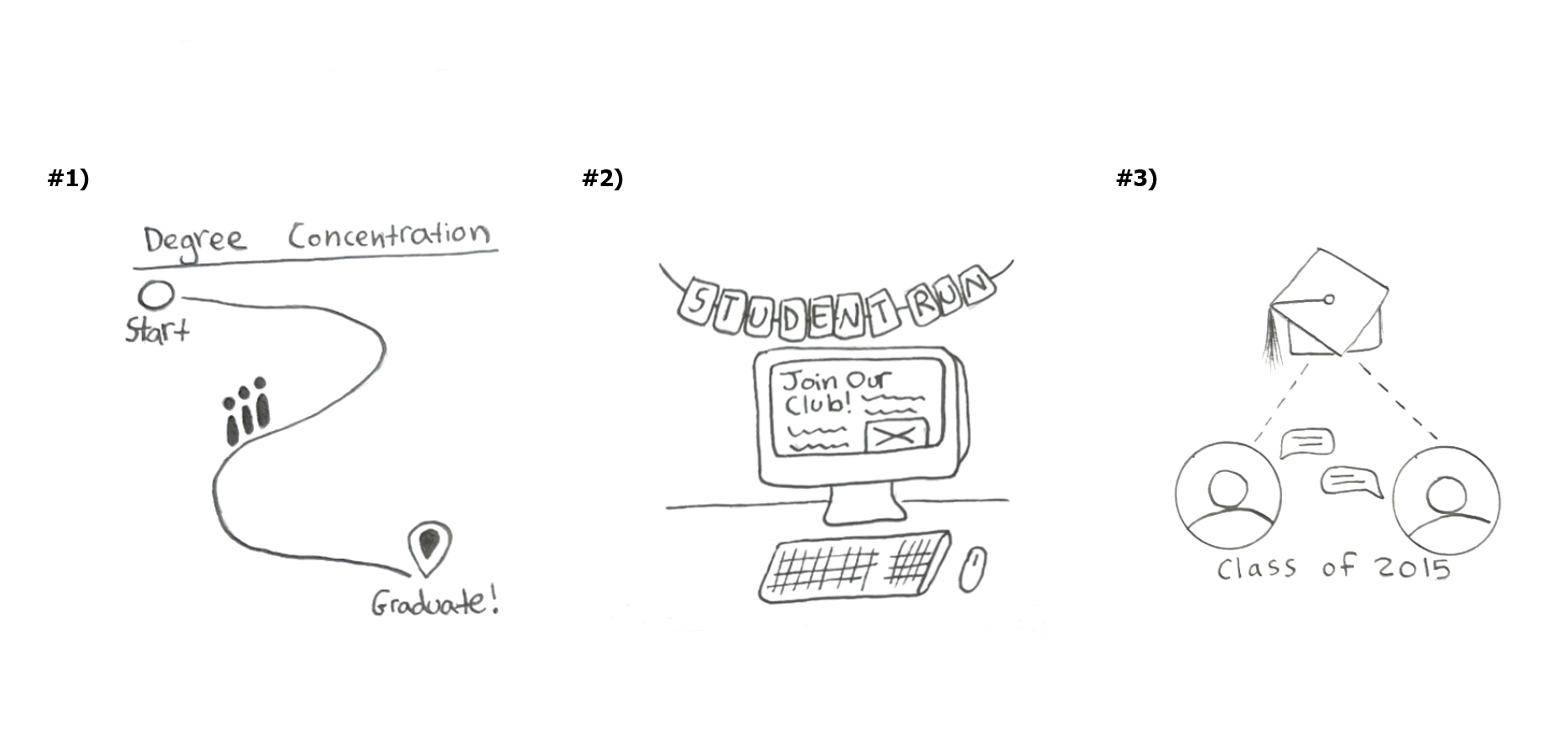
From here, I came up with five unique solutions based on what would help Andrea the most. Of course, with the design sprint, the ideas are quick and aimed at generating/testing fast, in order to get feedback sooner rather than later.
Below are my ideas:
- Have the ICM program be more linear by having students pick a concentration in the program. This way they will be taking a group of classes in order.
- Offer networking options within Blackboard/Canvas. This would be an opportunity for students to share not just their blogs, but their resumes, social media accounts, portfolios, and career opportunities with one another.
- Have students pair up with a partner at the start of class/program. These pairs will be linked at random or based on experience and background. The groups will also be asked to work on some projects together throughout the semester.
- Having a “social media-like account” or platform where students can link up based on graduation date or major.
- Including an in-person, mandatory class that requires group work for the ICM program.
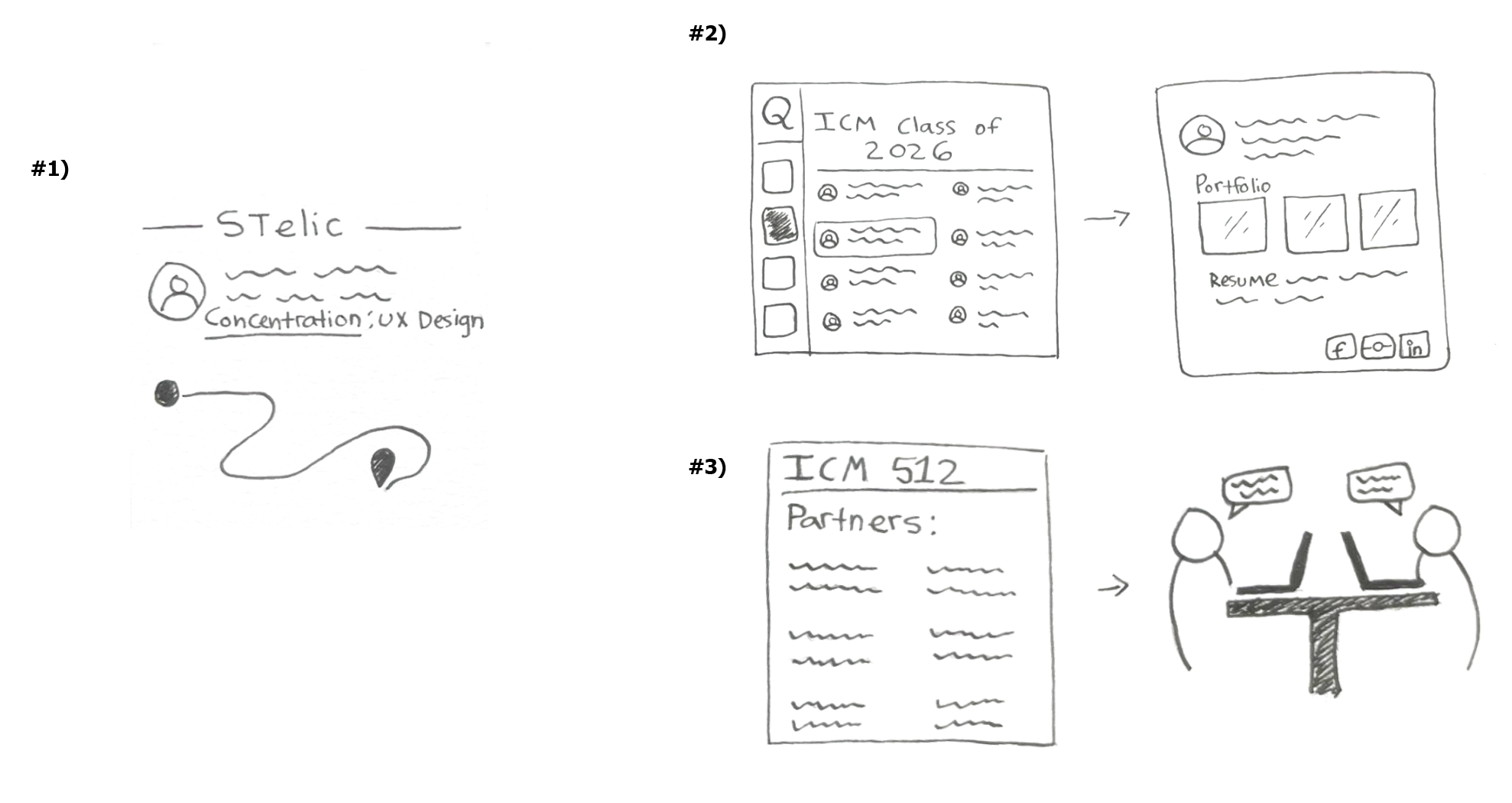
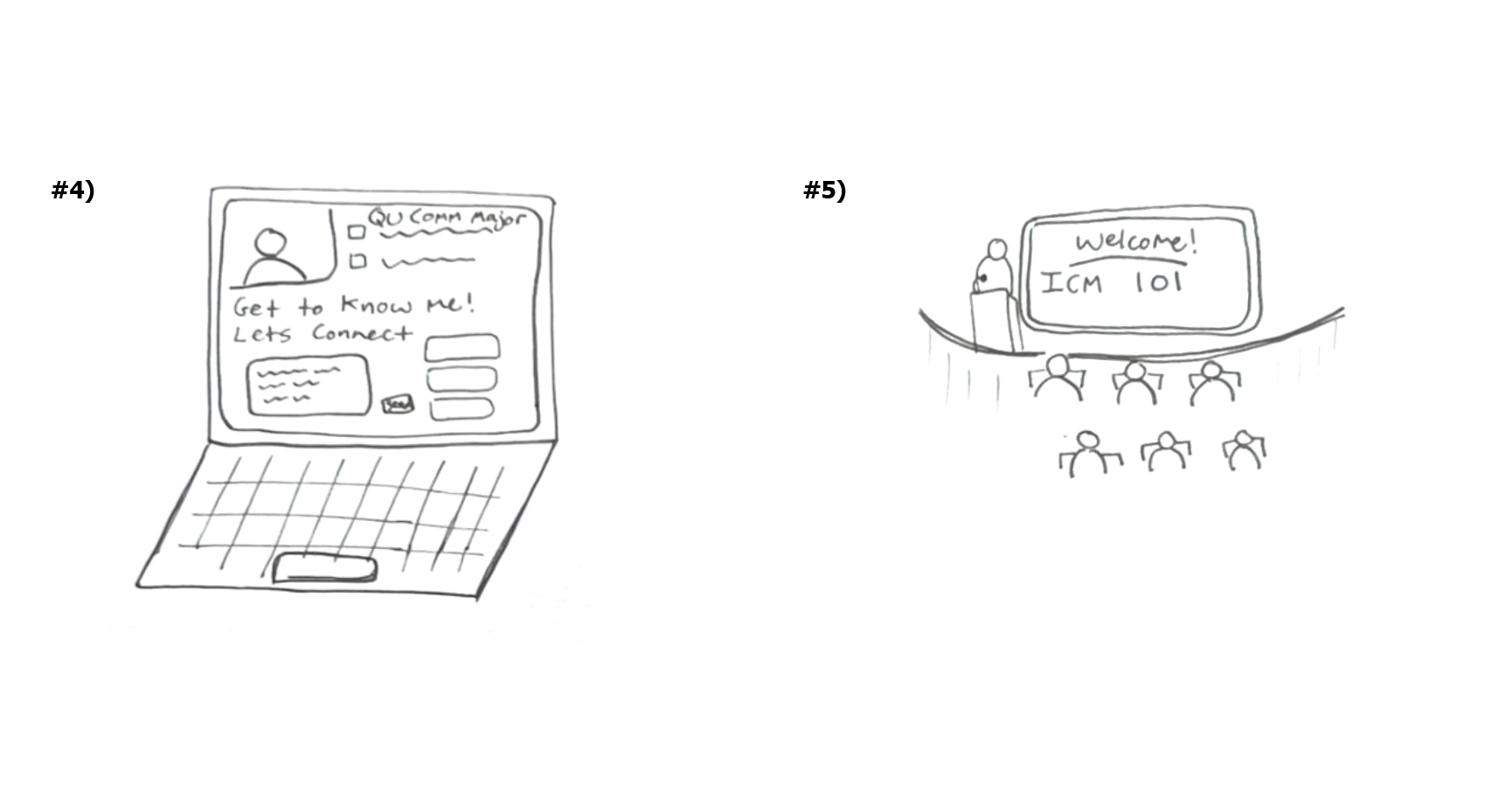
Step 3: Decide
When showing Andrea my quick concepts, she had positive things to say after each one. She initially was torn between ideas two and three but ultimately was drawn to the third option. She found the partner aspect very appealing. She also felt that getting to work with a partner on projects would allow her to gain experience working with other designers.
Of course, once she picked a concept, I questioned her a bit more, to understand what she liked and didn’t like about my initial sketches. It seemed that she wanted to gain more confidence working alongside other creatives, like a real design agency would operate. With that thought, I added some features to my idea, including making partners have weekly, virtual check-ins and allowing students to view other group’s work so that they could learn from all their peers.
Step 4: Prototype
With more feedback from Andrea, I was able to finalize my concept and sketch it in more detail. This prototyping stage in the design sprint let me put all of my changes and revisions into a low-fidelity mock up that can be tested. Each screen is drawn out, but it’s also not perfect, allowing me to go back and edit if necessary.

Step 5: Test
Once the prototype was finished, the last stage in the design sprint was to test. Andrea was able to see my final sketch and critique it. She mentioned she could see this being something all online classes use! The concept could benefit many students and there was little she was hesitant about. For her, the idea of having a partner that she could connect with, ask for feedback, and work alongside with, fulfilled her wishes. But one part she was unsure about was submitting work together as a group. She said it could be challenging but it’s still worth keeping.
Together we also discussed more broader issues like which programs should use this method, all online graduate classes? Should it just be for master’s programs? Should partners meet in person? All viable questions that I could implement into future prototypes.
For this complex problem where testing ideas needed to be quick, a design sprint made perfect sense. I honestly didn’t think I was going to have any good ideas from this process, because normally I’m not good at thinking on my feet. But even for me, the sprint was able to guide me by aligning goals, identifying the real problem, and reducing risk by quickly creating prototypes to get instant feedback. I’m proud of the solutions I came up with and I believe my final prototype could help a lot of students in online programs.
To see my full journey with Andrea you can view the full report below.

 The Creative Corner