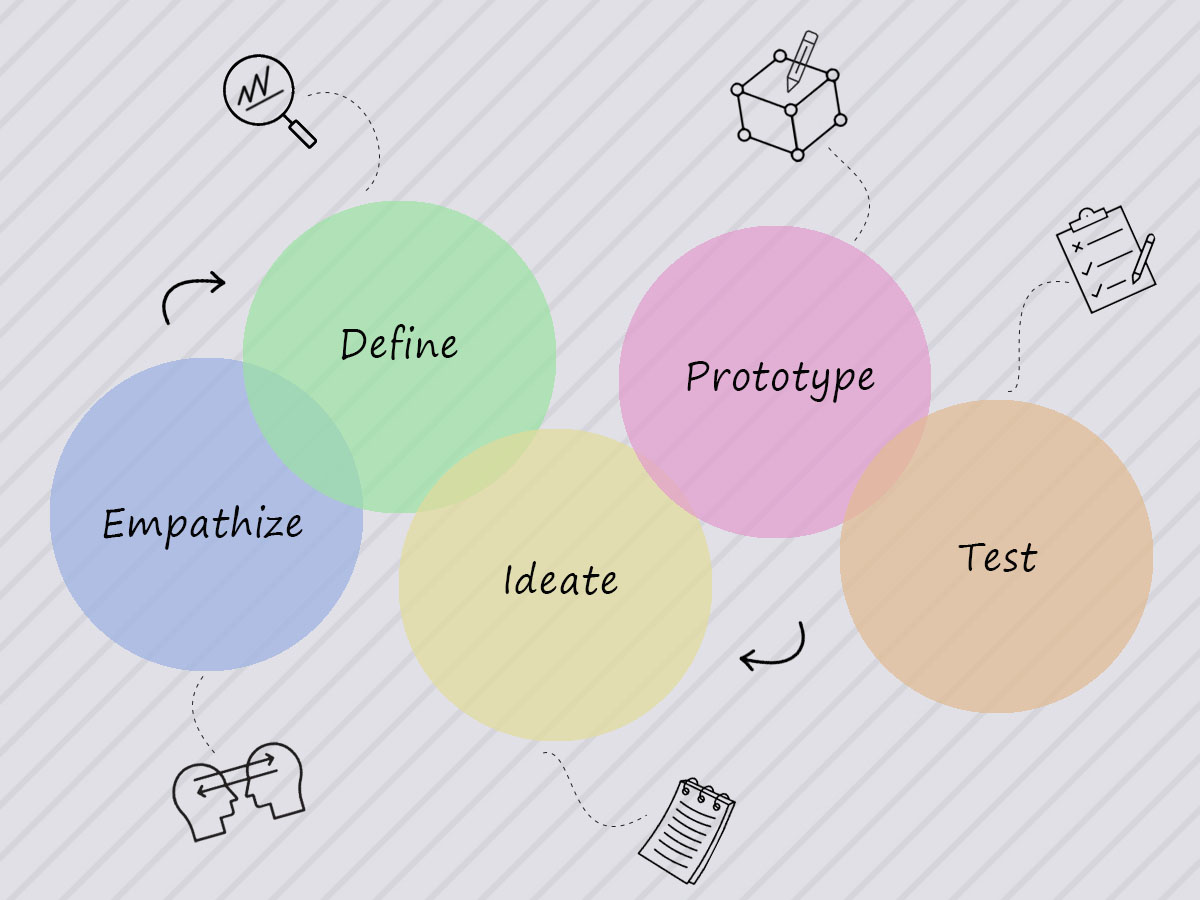
In today’s world, coming up with ground-breaking ideas is often the hardest part of any project. Finding solutions to problems is the oldest challenge around. Whether its professionally or personally, it’s important to know how to overcome these brain blocks and how to tackle issues to create solutions. One way we can solve complex problems is by using design thinking. In basic terms, design thinking is a human-centered, problem-solving process that helps people come up with creative solutions.
The 5 Phases
The five phases of this process are: Empathize, Define, Ideate, Prototype, and Test. This gives us a non-linear path that can be and often is repeated, until there is a desired result. Using this line of thinking also means you are aiming to understand user needs and once you know them, you can come up with better solutions.
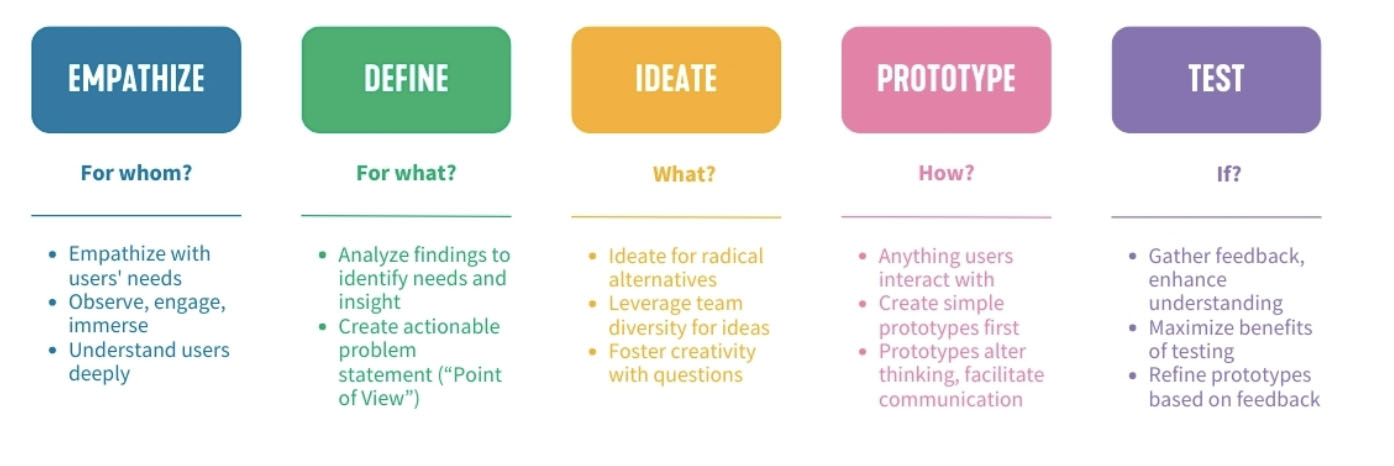
This methodology is proven to help professionals in all backgrounds problem solve. In WeWork’s professional blog, they also site how this process can benefit all organizations by favoring prototyping and testing, rather than blindly coming up with an idea you think people want. The design thinking way allows you to understand the real issue behind the product and reduce company risk by testing, before rolling out the solution. Even if you aren’t a designer or a creative at heart, these steps can help you create solutions quicker, no matter the problem.
Companies who use Design Thinking
You might be thinking at this point… “Well show me some real-life examples already!” and the truth is… there are plenty. UX design is one field where design thinking is implemented often and there are plenty of big-name companies who have created products this way, proving just how useful this method is.
One company is Oral-B. When designing their new electric toothbrushes, they were originally thinking about how to gather data on user’s brushing habits. But they learned through research that most people are already concerned about their brushing habits, and that this wasn’t a feature users wanted. So, to improve this model and make it easier to use, designers took their testing results and focused on what user’s actually told them they wanted. They discovered that users wanted an easy way to charge the toothbrush and to get new brush head replacements delivered fast. This let Oral-B spend time on solving the actual problem, rather than wasting valuable resources and money for a product that offers little value. By using design thinking they were able to create a product that was human centered.
American Express has also been cited as using design thinking. After listening to all of their customer’s feedback, they learned that their users needed more out of a financial institution. They saw that many young adults were worried about making large payments and would often use cash or debit instead of using a credit card, and therefore, missing out on rewards. In return, American Express took the time to come up with an online banking feature that solved this issue. It allowed them to choose how to pay- either pay for the item in full or break it into smaller payments. After multiple prototypes, and testing the new feature, they were able to launch: Pay it Plan it. Today, almost all American Express customers have access to this feature online. Without empathizing with the user and understand how they actually use credit cards, American Express never would have created one of their biggest features.

Why it Matters
Many main stream products that have come out of these five steps have a better outcome, all because user needs were put first. But besides creating great products, there can be even more benefits for the company and people who think this way. Design thinking helps teams think outside the box, not just come up with something pretty. Where there is a problem there is a better solution. Design thinking can also improve the collaboration within organizations, by allowing people from all departments to participate and share perspectives. The more insight, the greater the innovation. But lastly, it creates an iterative approach that shows designers that it’s ok to go back and edit, or to completely scrap an idea. This type of improving and refining can help us remember that what we make can always be improved.

Design thinking is not just a way to solve problems; it’s a way to foster creativity and develop a new wave of innovation in all markets. Many professionals, not just those with a designer title all say that design thinking has changed the way they work and think. Using it for my own projects, I have seen some of my best ideas flourish. I encourage everyone to remember these five steps the next time they are stumped with any kind of problem. Design thinking may be exactly what helps you reach a solution.

 The Creative Corner