As I start writing my first white paper, I have come across many different concerns of why most of us struggle to focus in the workplace. As someone who has worked in an office and from home, I know both the advantages and disadvantages of each. While there are plenty of people that will support either side, I have always enjoyed working from home more. At home, I feel more in control on what I work on and when, and I also feel there are less interruptions. In my research, I found that I wasn’t the only person feeling like offices were more distracting than helpful. In fact, most people want to change the way they operate, they just don’t know where to start.
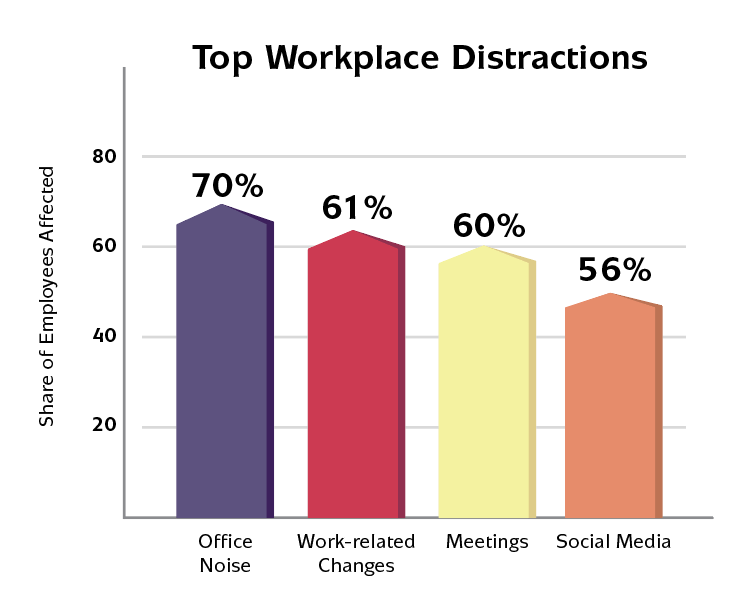
One of the major problems in all workplaces, not just in designer roles, are the number of distractions in a workday. According to a Zippa statistic, 79% of U.S. employees report being distracted at work. Some top distractions are office noise, figuring out work-related changes, and social media. I can relate because in my professional career, I have been affected by all of these distractions, multiple times. I even consider it odd if the office is too quiet or unusual if no one has stopped me to ask me something. I know going into an office is an environment that will prevent me from finishing all the work that I need to complete. However, I do recognize that some of the distractions are of course our own fault, like checking our phones constantly and needing social media breaks. But I do believe it is because we are surrounded by other interruptions that end our deep train of thoughts and flow. Workplace noise is frustrating enough and often leads to dissatisfied employees who have a hard time completing their work.
These distractions in our workplaces are not just affecting the workers, but they affect the overall company as well. Even small interruptions can increase work errors by two times! This means distracted workers affect their company’s bottom line, losing around $650 billion annually! This really made me stop and realize just how dangerous a chaotic work environment is! While everyday may seem like you have gotten just enough done, I think most of us are not working even near our full potential!
Another example of struggling to focus in the workplace is something called task-switching. It usually starts with an interruption of some kind, where we decide to switch over and focus on this new thing instead of what we were originally working on. Then we eventually return to the first task to complete it, thinking that we are multi-tasking. But in fact, we are just delaying the completion of both tasks because as humans, we simply cannot focus on more than one thing at a time. In an office, this is extremely common, because we are constantly being bombarded with phone calls and emails which we feel we need to answer immediately. But this back and forth requires our brains to reorient, meaning that during these times we are not productive. In an eight-hour workday, just stopping to check emails adds up to 1.5 hours of reorienting!
All these statistics have backed up what I have noticed and felt over my 10 years of office work. Now, I want to help change the way we all function in an office setting. Most workplaces will just continue down this path where their workers feel more defeated and underappreciated if this topic is not brought to light. As I continue to write my white paper on this topic, I encourage my readers to follow up with their own employers to make adjustments in their own offices. Imagine workplaces of the future that actually supports our thinking and creating, and what great work could come out of it!

 The Creative Corner