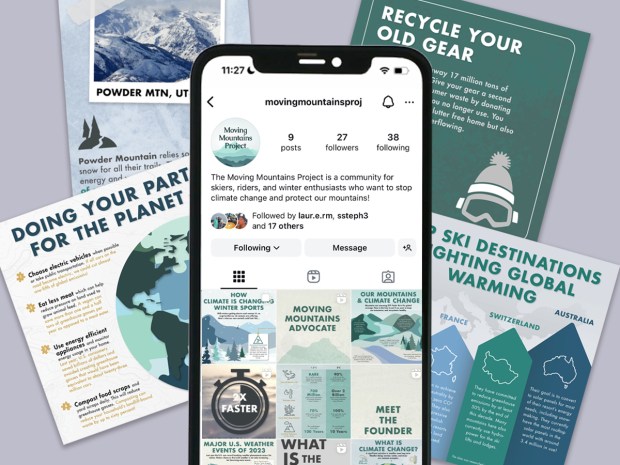
Reminiscing at the end of my Social Media Project
As the final week of my project comes to a close, I feel a bit out sorts of what I will do will all my free time after this project ends. For the past six weeks, I have spent many hours preparing, designing and posting about climate change and how the skiers and snowboarders in my area can help to do their part for the planet. While this project has been an overwhelmingly positive experience, it feels a little surreal that I’m done with the research and design part, and almost done posting to Instagram! As I have been watching my grid fill up with posts, I have only recently realized that I finished all I had set out to do with the campaign.
Most of this week’s research focused on what my fellow followers can do for the planet and where to start. I wanted to provide beyond the basic ideas like recycling or driving less, which is always everyone’s go to when talking about saving the environment. I wanted to really dive into different ways that could make a difference if done consistently. One of my sources in my bibliography made a really helpful starting point for me, and this was a simple illustrated YouTube video, which you can view below.
While this video was simple it led me to a series of additional videos that I hadn’t seen before which became a great resource for me. One idea I learned about in one of the videos was to eat less meat or become vegetarian. This helps the planet because plant-based foods require less land and fewer resources. They even produce less greenhouse gas emissions. When comparing a vegetarian diet to a meat-based diet, it was clear that you can have a smaller carbon footprint by about 25% just by making this simple change. That one piece of advice has now transferred into my own personal life just because I find this an easy change I can put into practice. We don’t necessarily have to go full vegetarian to help the earth, but we can limit how much meat we are eating on a weekly basis. When we think of it like that, it seems much more attainable. If you would like to learn more about this topic, I recommend you visit the Fair Planet’s site which helped me learn more about limiting meat consumption and covers how much raising animals for produce harms the environment.
Positive Change for Ski Resorts and Our Future
As the researched continued, I also focused on what ski areas around the U.S. were doing to help the environment. Many articles on Skimag.com provided great insight into where skiing is headed and what we can expect from the sport in the future. This part of the research was very exciting to read about, because I had not heard much and figured these big corporations were more concerned about just making money. But it turns out that many resorts are thinking ahead and trying to preserve winter and our sports as much as possible. In the article 5 Innovative Ways Ski Areas Are Reducing Their Carbon Footprint they list many resorts as being innovative thinkers and taking responsibility into their own hands. For example, Jay Peak in Vermont uses waste heat to heat their indoor water park. The waste heat comes from making ice for their ice-skating rink. That way the least amount of energy is created and wasted. This one switch alone reduces their propane consumption by sixty percent!
Wolf Creek in Colorado has teamed up with a solar farm and now operates fully off solar power! This was quite amazing to hear that a resort completely changed their operations so drastically, a change that cost them thousands of dollars to do. The best part was that converting to solar power has allowed them to claim that they took around 250 cars off the road last year just by operating this way. Just imagine after a couple of seasons, how much emissions they will save.
There were many other ski areas on the list taking action, and I’m happy to report I’m not the only one thinking about what our winters will look like a few generations from now. Even the U.S. Olympic ski and snowboard organization has an article on how we can do our part to protect the mountains. This particular article I found to be even more relatable because it lists easy choices we can make like recycling our old gear or carpooling to the mountains. Things that take very little planning or effort in our day. It’s been relieving to see that no matter what coast we live on or in what country, there is always a way we can help save our winters and our planet. With resorts that are already a few steps ahead and doing their part to limit emissions and saving electricity, we as a community should be able to do small changes that can also have positive impacts on our earth. This means that even though our sports may rely on power to get us up the mountain, it doesn’t mean we have to use the same methods that’s got us into this global warming problem. There is always room for improvement, and it seems that we are well on our way to running more efficiently and being able to ski for years to come!
 The Creative Corner